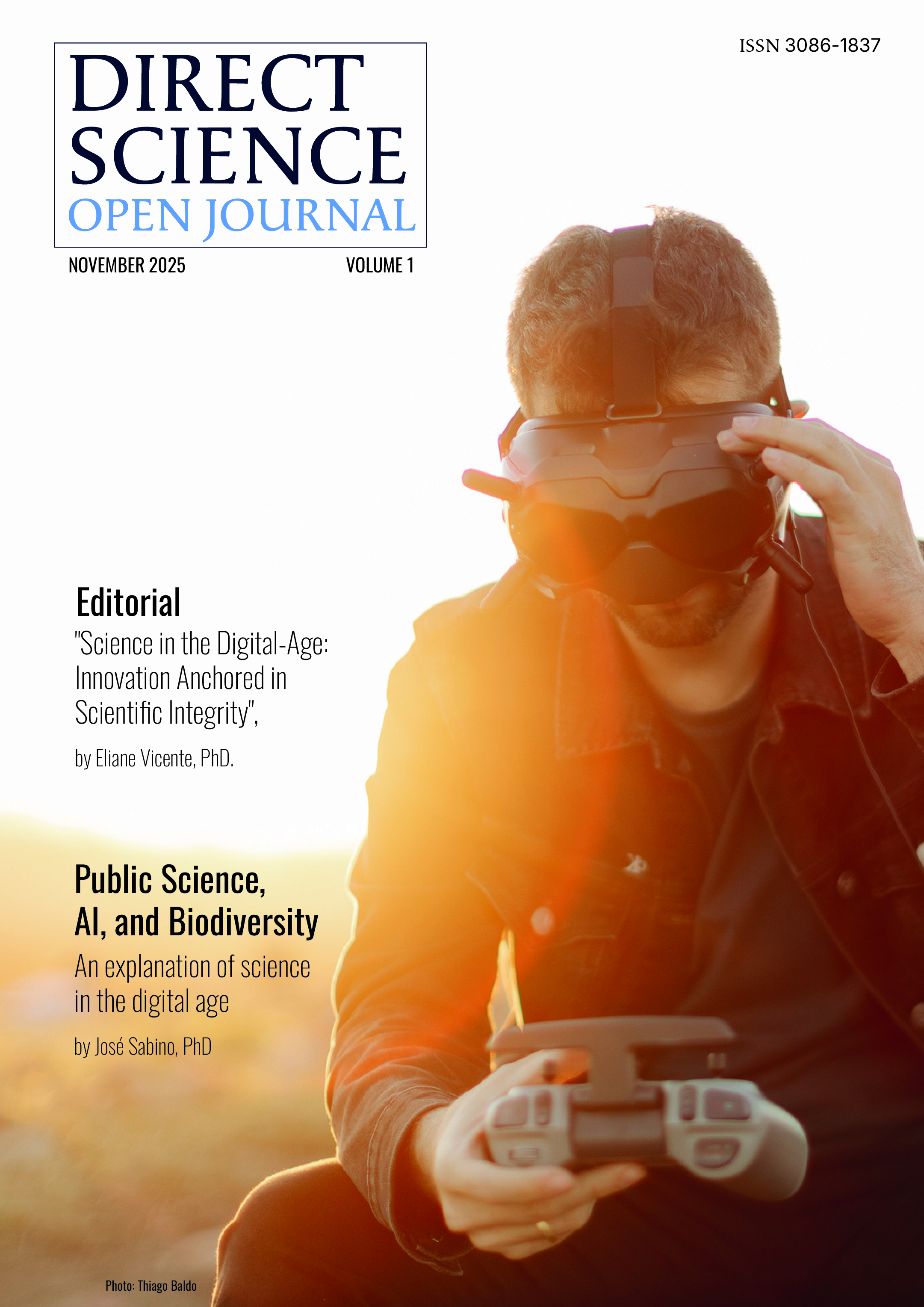
In Conversation with Professor José Sabino, Ph.D.: Science in the Digital Age.
Abstract
Within the editorial theme of this inaugural edition ("Science in the Digital Age"), we invited Professor Dr. José Sabino, a member of a select group of researchers whose career combines scientific rigor and a commitment to the dissemination of biodiversity. His experiences and accumulated knowledge were generously shared in a dialog that enriches critical reflection on the contemporary challenges of scientific research and knowledge communication.
José Sabino is a biologist and holds a PhD in Ecology from the State University of Campinas (Unicamp), with 35 years of experience in biodiversity conservation and the study of animal behavior. His career combines teaching, research, scientific management, and outreach. He was a professor at institutions such as PUC-SP, Uniderp, and UEMS, and is currently a Visiting Specialist Professor at the Gleb Wataghin Institute of Physics at Unicamp, where he teaches interdisciplinary courses focused on the environmental crisis and sustainability.
He contributed to the training of approximately 1,900 naturalist biologist-photographers and coordinated postgraduate courses in ecology, sustainable tourism, and scientific communication in the digital age. He served as a public manager, holding the position of Superintendent of Science and Technology for the State of Mato Grosso do Sul (2007–2008), and was a member of national scientific councils, such as BPBES and PPBio.
He is the coordinator of the Peixes de Bonito Project, nationally recognized for integrating ecotourism, ecosystem services, and environmental conservation. Simultaneously, he established himself as a nature documentarian and photographer, amassing a collection of approximately 60,000 images of Brazilian fauna. Since 1992, he has been directing the production company Natureza em Foco, specializing in environmental communication and biodiversity. He also worked as a science journalist at Folha de S. Paulo and as a consultant for productions by BBC, National Geographic, Discovery Channel, and Netflix.
Resident in Mato Grosso do Sul since 2000, near the Pantanal and the Bonito region, he is dedicated to uniting science, art, and emotion to raise awareness in society about the value of Brazil's natural heritage.
Published
How to Cite
Issue
Section
License
Copyright (c) 2025 Direct Science Open Journal

This work is licensed under a Creative Commons Attribution 4.0 International License.